

How Much Does a Public Adjuster Cost in Florida?

💰 How Much Does a Public Adjuster Cost in Florida?
The cost of hiring a public adjuster depends on the type and complexity of the claim, the amount of work involved, and the compensation terms in the agreement. Many public adjusters work on a percentage-based or contingency-fee basis, meaning their compensation is tied to the insurance payments or settlement obtained through their work.

Florida law limits how much a public adjuster can charge. For claims related to an event declared a state of emergency, the statutory limit is generally 10% of applicable insurance payments during the first year after the declaration. For claims that are not based on a declared emergency, the general limit is 20%. Certain circumstances may be subject to different rules, so homeowners should review the terms of their specific agreement rather than assume that one percentage applies to every claim.
📄 What Determines the Cost of a Public Adjuster?
The agreed percentage is only part of the overall cost. The amount ultimately paid can vary depending on the size and complexity of the loss and the work required to document and manage the claim.
Factors may include:
The total amount of the covered loss
The number and type of damaged areas
The complexity of determining the repair scope
The records, estimates, photographs, and other documentation required
The amount of communication and negotiation involved
Whether the claim requires supplemental or additional documentation
A larger claim can result in a higher fee even when the same percentage applies. Conversely, a smaller claim may still require substantial work if the damage is difficult to document or the repair scope is complicated.
🧾 What Should a Public Adjuster Agreement Include?
Before signing, homeowners should understand exactly how the fee is calculated and what services are included. Florida's requirements for public adjuster contracts include disclosures about compensation, the method used to calculate it, and other fees or amounts the policyholder may be responsible for.
The agreement should clearly explain:
💰 The percentage or other compensation method
🧮 What insurance payments are included in the calculation
📅 When the fee becomes payable
🛠️ What services the public adjuster will provide
💵 Whether additional expenses may be charged or reimbursed
📑 How supplemental, reopened, or additional payments are handled
Looking beyond the headline percentage can help homeowners understand the actual financial commitment before entering into an agreement.
💵 How Is a Public Adjuster's Fee Calculated?
Public adjusters commonly use a contingency-based fee structure rather than charging an hourly rate. Under this arrangement, compensation is generally tied to insurance payments or settlements obtained through the public adjuster's work.
Florida law also establishes rules governing the amount on which compensation can be based. In general, the calculation is tied to claim payments or settlements obtained after the public adjuster agreement is entered into, and policy deductibles are excluded. Additional rules may apply to payments received before the agreement, supplemental or reopened claims, and certain types of coverage.
Because the calculation can depend on the circumstances of the claim, homeowners should review the actual agreement carefully and make sure they understand both the percentage and the payments to which it applies.
However, compensation terms can vary between firms, so the contract should always be treated as the controlling document for the specific engagement.
Fee Detail | What to Check |
Compensation rate | What percentage is stated in the agreement? |
Payment basis | Which insurance payments are included? |
Deductible | Is the deductible excluded from the calculation? |
Additional costs | Are any expenses reimbursable? |
Supplemental work | How are reopened or supplemental claims handled? |
Cancellation | What cancellation rights apply to your contract? |
This is why two firms advertising different percentages should not be compared on that number alone.
📝 Public Adjuster Percentage Fee: What Else Should You Review?
A lower percentage does not automatically mean the agreement is less expensive overall, just as a higher percentage does not automatically mean you receive more comprehensive service. The scope of work matters. Ask what the firm will actually handle, including inspections, estimates, claim preparation, documentation, communication with the insurer, and negotiation. Also determine whether outside services or other expenses could be charged separately. Florida's Department of Financial Services advises consumers to verify that a public adjuster is licensed and to review the contract carefully before signing.
🏠 What Does the Fee Mean for a Property Damage Claim?
The economics can look different depending on the size and complexity of the loss. A straightforward property damage claim involving one repair may require less work than a major loss involving roofing, water intrusion, structural repairs, contents, temporary protection, and multiple contractors. Documentation requirements can also affect the workload. A claim involving photographs, contractor reports, inventories, repair estimates, and several inspections requires more organization than a simple loss with a clearly defined repair. The right question is therefore not simply, “What percentage do you charge?” It is also, “What am I receiving for that fee?”
🤝 How Claim Representation Affects the Cost
When you hire a professional, you are paying for claim representation as outlined in the agreement. That may include preparing claim materials, evaluating the scope of loss, communicating with the insurer, and handling negotiations. Florida law requires a written contract for a public adjuster to collect fees for services on payments made to a named insured. It also gives consumers specific cancellation rights, including a longer period for certain contracts connected to declared emergencies.
💰 What Happens to Your Insurance Proceeds?
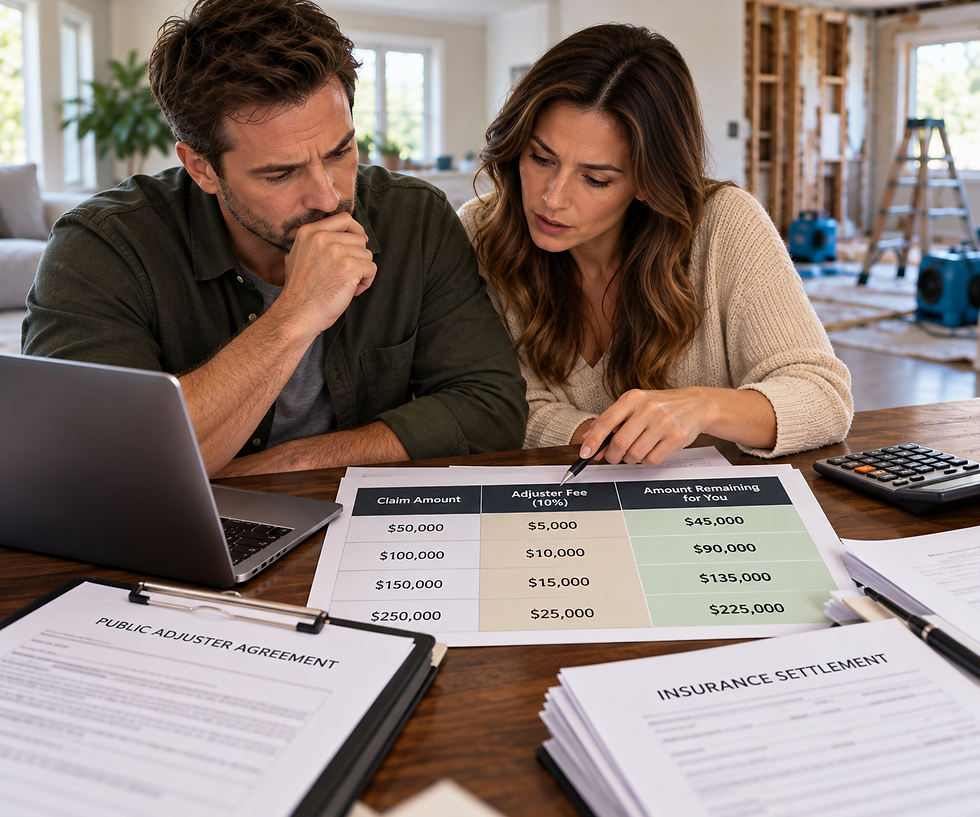
The fee arrangement matters because the amount paid to the adjuster can affect how much of the insurance proceeds remains available to the policyholder for repairs and other covered expenses. Before signing, calculate what the agreed fee would mean at different possible claim amounts. Then review whether the agreement contains any separate costs that could change the total amount you pay. For example, a homeowner considering a 10% arrangement should understand that the dollar amount increases as the claim payment increases. The same principle applies to any percentage-based structure.
🔍 Why Claim Size Isn't the Only Factor
A $50,000 loss may be relatively straightforward to document, while a smaller loss could involve multiple rooms, concealed damage, several contractors, and complicated policy questions. Complexity can affect the amount of work required from the professional. Homeowners should consider the overall scope rather than choosing based entirely on the advertised rate.
🛠️ How Base Claims Structures Its Fees
Base Claims states that its residential public adjusting services use a contingency-based structure, with published limits for new and reopened claims. Its fees page explains the firm's current structure and distinguishes residential claims from commercial claims. For homeowners comparing options, the important step is still to review the actual agreement and confirm exactly what services and costs apply to their particular claim.
🌿 Before You Sign a Public Adjusting Agreement
Do not judge a firm only by its advertised rate. Read the public adjusting agreement from beginning to end and make sure you understand how compensation is calculated, what work is included, what expenses may be charged, and what happens if the claim changes. Florida's Department of Financial Services notes that public adjuster contracts are legally binding and provides consumers with contract information and cancellation requirements. If anything is unclear, ask for an explanation before signing rather than assuming the term means something different.
❓ Common Questions About Public Adjuster Costs
How are public adjusters usually paid?
Many public adjusters work under a fee arrangement tied to insurance claim payments or settlements obtained through their work. The exact structure should be stated clearly in the written agreement, including the applicable percentage and other compensation terms. Florida law also places limits on what a public adjuster may charge in certain circumstances.
Does a public adjuster charge an upfront fee?
Not necessarily. Fee arrangements vary between firms and contracts, and some use contingency-based compensation rather than an upfront payment. Homeowners should read the agreement carefully to understand when fees are earned, how they are calculated, and whether any separate costs apply.
Can public adjuster fees vary by claim?
Yes. The agreement, type and complexity of the loss, applicable Florida requirements, and circumstances surrounding the claim can affect the fee structure. Certain claims are subject to specific statutory limits, so homeowners should not assume that the same percentage applies to every situation.
What should I check before signing a public adjuster contract?
Review the compensation rate, payment basis, additional expenses, services included, cancellation terms, and any provisions concerning supplemental or reopened claims. Florida's contract checklist requires compensation and fee information to be disclosed in the agreement, so make sure you understand those terms before signing.
📞 Compare the Agreement, Not Just the Percentage
The cost of a public adjuster is ultimately about more than a number on a contract. Look at the fee structure, the complexity of your loss, the services included, and the terms governing payment. If you are considering professional help with a Florida insurance claim, Base Claims can review your situation and explain how its services and fee arrangement apply to the claim.

Benjamin Licht 954-589-8710
Office 954-466-5730
Don’t wait until it’s too late.



Comments